Graph Databases And Ruby
Using Neo4J to make applications based around graphs
What is a Graph?
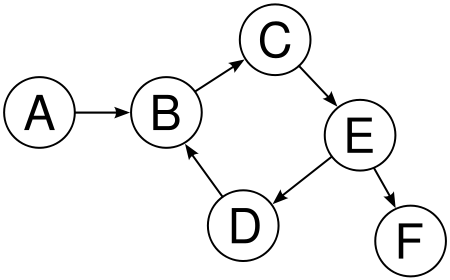
A series of vertices connected by edges
Each vertex represents an entity in the graph
Each edge is a relationship between two entities
Can be directed or undirected
Edges and Vertices can have properties
What it looks like
What can they model?
Anything that has relationships between things
A social network
Item catalogues
Movie listings with actors/directors/genres
User interactions
Why use them?
Easier to model data with relationships
Easier to do complex traversals between nodes
Traversal is more efficient than tables, nodes link directly by reference
Look Ma, no JOINs!
Quick view
Make some stuff
CREATE (a:Person {name:'A'} )
CREATE (b:Person {name:'B'} )
CREATE (c:Person {name:'C'} )
CREATE (d:Person {name:'D'} )
CREATE (a) -[:Friend]-> (b)
CREATE (a) -[:Friend]-> (c)
CREATE (a) -[:Friend]-> (d)
CREATE (b) -[:Friend]-> (d)
CREATE (c) -[:Friend]-> (d)
Search some stuff
MATCH (me:Person)-->(friend:Person)-->(friend_of_friend:Person)
WHERE me.name = 'A'
RETURN count(DISTINCT friend_of_friend), count(friend_of_friend)
With code!
query = "CREATE (n { nodes })\nRETURN n AS node"

nodes = {
  :nodes => [{
    :name => "Foo"
  }, {
    :name => "Bar"
  }, {
    :name => "Baz"
  }]
}

@neo.execute_query(query, nodes)
Cypher
MATCH (node1:LABEL{property:"value"}) -[relationship:LABEL]-> (node2) RETURN node2A query language made for Neo4J
Makes traversing graphs as simple as ascii art
Language is similar to SQL
Read operations
Patterns : Patterns describe nodes or paths
MATCH: Searches for nodes, relationships, or paths that match a given patternWHERE: Narrows down the search with additional constraintsRETURN: Return the results for the queryORDER BY: Order the results of the querySKIP/LIMIT: Number of results to skip / Max number of results to get
Write operations
CREATE: Creates new nodes or relationshipsMERGE: Match a pattern, or create it if it doesn't existSET: Set a property of a node or relationshipDELETE: Delete a node or relationship from the graphREMOVE: Remove a label or property from a node/relationship
Example graph
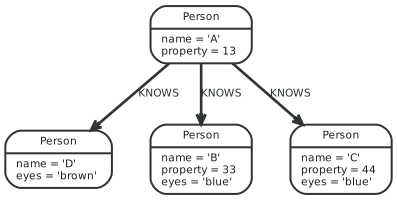
Find the number of unique relationships
MATCH (a)-[r:KNOWS]-(b)
RETURN count(DISTINCT r) As relationships| relationships |
|---|
| 3 |
Find all the names, alphabetically
MATCH (n)
RETURN n.name AS name
ORDER BY n.name| name |
|---|
| A |
| B |
| C |
| D |
Add some rivalries
MATCH (a { eyes: "brown" })
WITH a
MATCH (b { eyes: "blue" })
WITH a, b
CREATE (a)-[h:HATES]->(b)
RETURN h AS hate| hate |
|---|
| (0)-[3:HATES]->(2) |
| (0)-[4:HATES]->(3) |
Everyone (without blue eyes) who knows someone that knows someone with blue eyes
MATCH (a)-[:KNOWS]-(b)-[:KNOWS]-(c { eyes:"blue" })
WHERE NOT a.eyes = "blue"
RETURN DISTINCT a AS who| who |
|---|
| (0:Person {eyes:"brown", name:"D"}) |
Find the most popular person
MATCH (a)-[r:KNOWS]-(b)
WITH a.name AS name, count(r) AS knows
RETURN name, knows
ORDER BY knows DESC
LIMIT 1| name | knows |
|---|---|
| A | 3 |
Using with Ruby
neo4j-core : Wrapper for entire Neo4J API for ruby. Supports embedded Neo4j when using JRuby
neo4j : An Active Model wrapper that users neo4j-core
neography : A wrapper over the Neo4j REST API
Using Neography
Get a server URL (default url for local servers is http://localhost:7474)
Make a connection
@neo = Neography::Rest.new("http://localhost:7474");- Disregard the rest of the API and just run queries!
@neo.execute_query("MATCH (n) WHERE n.name= {name}", {:name => "A"});Summary
Represent your data as nodes connected by relationships
Traverse complex relationships without the overhead of joins
Simple query language that's similar to SQL
Fun!